
Installing a Tankless Water Heater in an Older Home: What You Need to Know
Older homes often need gas line upgrades, venting changes, or electrical updates before tankless installation. Here's how to plan around them.
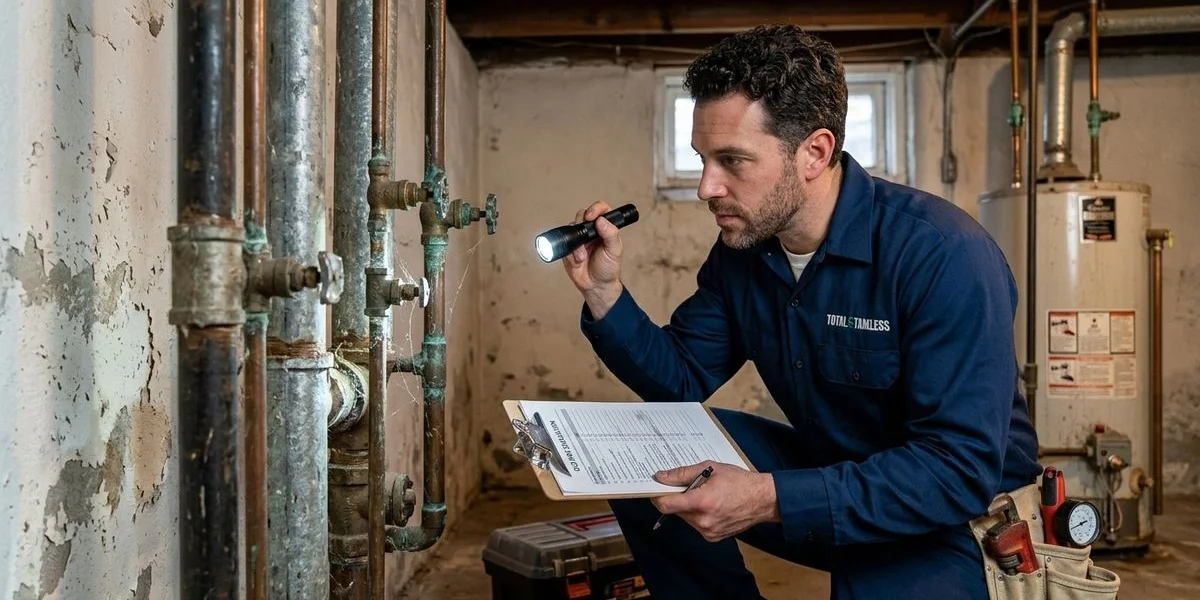
Our professional service team has noticed that outfitting a vintage house with modern plumbing tech is rarely straightforward. Older homes have character, history, and charm. They also have gas and electrical systems designed for the technology of their era.
Our estimators often see infrastructure limitations that heavily impact the scope, cost, and feasibility of a retrofit.
Upgrading to an on-demand system requires careful planning to avoid surprise expenses. If your property was built before 1990, reading a guide on installing a tankless water heater in an older home: what you need to know is essential. We will break down the specific challenges you will face and walk through the exact workarounds professionals use.
The Good News First
We want to reassure you that the vast majority of older homes can accommodate a high-efficiency on-demand unit. The challenges described below add cost and difficulty, but they are absolutely solvable. Thousands of pre-1990s homes across the US have been successfully converted to tankless systems.
Our technicians frequently install advanced models like the Navien NPE-A2 or the Rinnai Sensei series specifically because their flexible venting and gas options cater to retrofits. When looking into installing a tankless water heater in an older home: what you need to know begins with understanding the financial upside. The 2026 federal Energy Efficient Home Improvement Credit (25C) offers up to $600 for condensing units with a Uniform Energy Factor (UEF) of 0.95 or higher.
We find that these rebates, combined with long-term energy savings, help offset the initial installation premium. These financial perks make the initial investment much easier to justify. Upgrading your plumbing is a smart move for your property value.
Challenge 1: Undersized Gas Lines
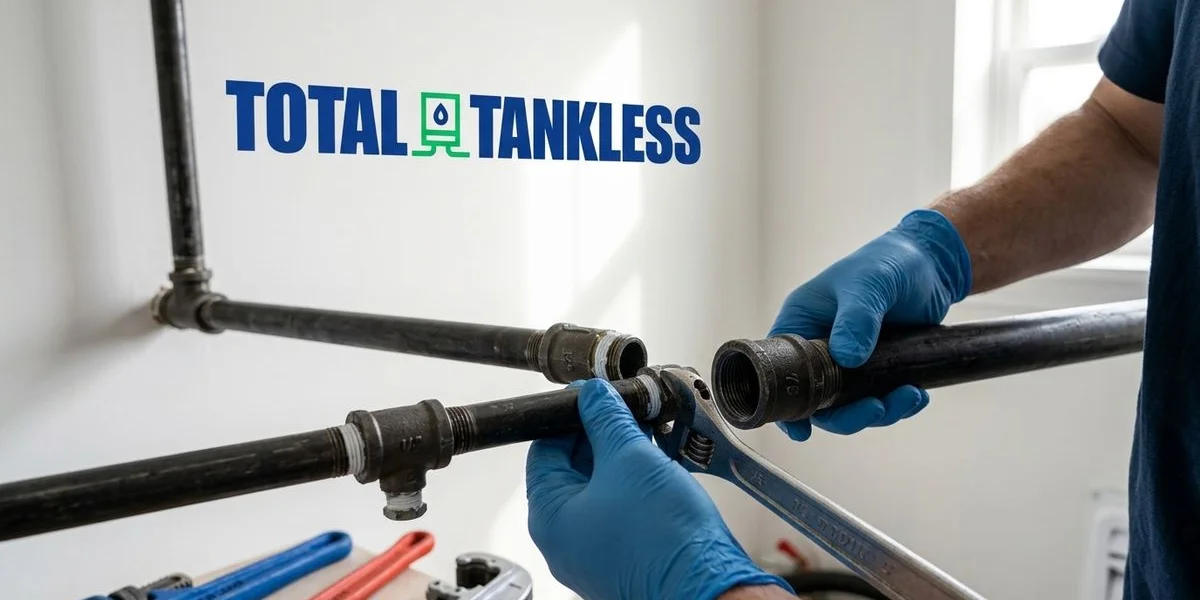
We see undersized gas lines as the most frequent hurdle in older properties. Traditional tank units use 30,000 to 50,000 BTUs and run perfectly fine on a half-inch pipe. A standard on-demand system needs 150,000 to 199,000 BTUs to function.
Our experience shows that this increased load usually requires a three-quarter-inch gas line at minimum. Many older residences feature a half-inch pipe running directly from the meter to the utility space. Some layouts have gas distribution manifolds that are already operating near maximum capacity.
We know that adding a high-BTU unit to an undersized system causes dangerous pressure drops. Upgrading the gas line from the meter typically costs $300 to $1,500 depending on the routing distance. You might also need the utility company to upgrade the main meter to handle the extra volume.
The Half-Inch Pipe Workaround
Our team occasionally utilizes a specific hardware workaround to save clients significant money. Advanced condensing models can sometimes operate safely on an existing half-inch pipe for runs up to 24 feet. This approach requires precise testing of your home’s water column pressure.
We always verify these metrics before recommending this specialized hardware. An undersized line will permanently damage your new appliance. A professional assessment is the only way to know for sure.
Challenge 2: B-Vent to Direct Vent Conversion
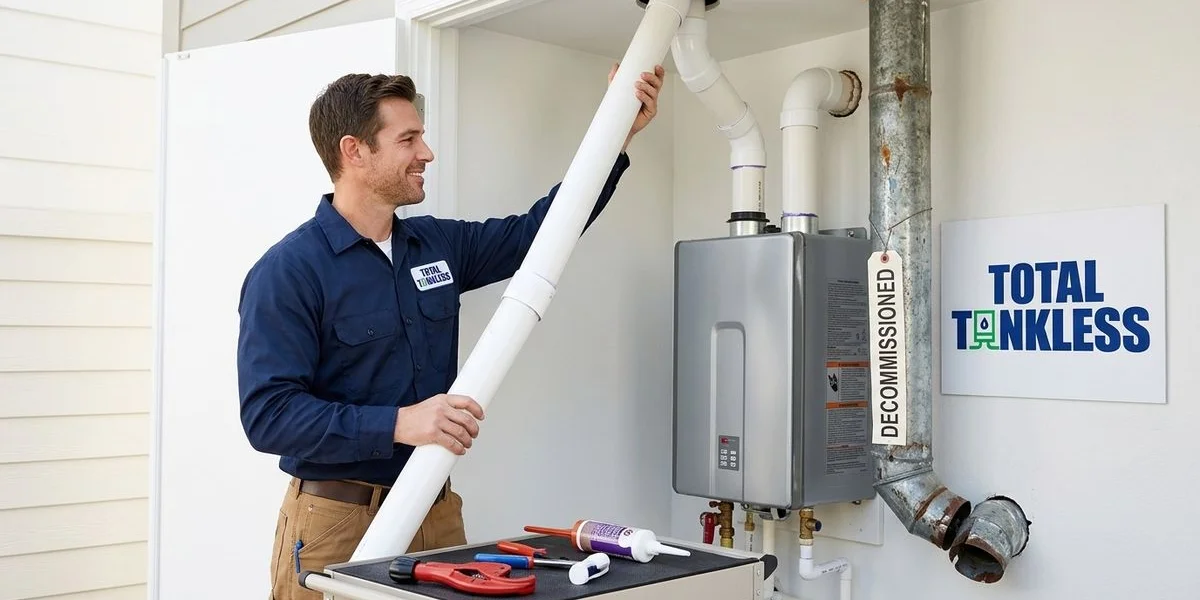
We must address the significant differences in exhaust systems during any retrofit. Older tank water heaters use atmospheric venting, also known as B-vent. This older method relies on natural convection to carry exhaust gases up through a metal chimney pipe and out the roof.
Our installers cap and seal this obsolete chimney pipe at the roof penetration to prevent water intrusion. Tankless water heaters use powered direct venting with a fan that pushes exhaust through plastic pipes. This exhaust must exit through an exterior wall rather than the roof.
We pay very close attention to municipal building codes when routing these new vent pipes. New direct vents must maintain strict clearances from windows, doors, and property lines. The US code generally mandates that exhaust vents terminate at least 12 inches away from any operable window or door.
Condensing vs. Non-Condensing Vents
Our safety protocol includes evaluating the remaining furnace vent to prevent potential carbon monoxide hazards. A shared chimney that is suddenly oversized for only the furnace may not draft properly. You also have to choose the right venting material based on the heater type.
We want to point out that non-condensing units exhaust at temperatures up to 400 degrees Fahrenheit. These extreme temperatures require expensive Category III stainless steel venting to meet safety standards. Condensing models run much cooler at roughly 100 to 120 degrees Fahrenheit.
Our default recommendation is a condensing unit because it safely utilizes affordable Category IV PVC or CPVC piping. This choice saves hundreds of dollars in material costs alone. Proper venting ensures your family stays safe from dangerous fumes.
Challenge 3: Electrical Panel Capacity
We frequently encounter electrical limitations in properties built before 1990. Gas tankless water heaters require a dedicated standard 120-volt outlet for the electronic ignition system. This setup typically draws fewer than 5 amps and rarely causes issues.
Our perspective changes dramatically if a homeowner wants to install an electric whole-house unit. Electric tankless models demand massive amounts of power to flash-heat water instantly. A standard whole-house electric heater requires 150 to 200 amps of dedicated electrical capacity.
We usually see these electric units hooked up to three or four 40-amp double-pole breakers. Many vintage houses run on original 100-amp or even 60-amp electrical panels. These older boxes simply cannot accommodate an electric tankless load without a heavy-up service upgrade.
Our electrical partners typically charge $1,500 to $3,000 for a full panel upgrade. This major renovation requires utility company coordination, costly permits, and municipal inspections. Gas-powered units remain the most practical path forward assuming natural gas service is available.
Comparing Electrical Requirements
We use this simple breakdown to explain the massive power differences. A gas unit utilizes electricity only for basic operations, while an electric unit uses it for heavy heating. This reality makes a gas unit the logical choice for older electrical systems.
| Specification | Gas Tankless Unit | Electric Tankless Unit |
|---|---|---|
| Voltage Required | 120 Volts | 240 Volts |
| Total Amperage | Under 5 Amps | 150 to 200 Amps |
| Breaker Type | Single 15-Amp Breaker | Three to Four 40-Amp Breakers |
| Panel Upgrade Needed? | Rarely | Almost Always |
Challenge 4: Water Heater Location and Space Constraints
We know that vintage homes rarely feature spacious utility rooms. The existing tank usually lives in a tight closet, an unfinished basement corner, or a cramped space under the stairs. A standard 50-gallon tank measures about 60 inches tall and 20 inches wide.
Our preferred tankless models are much smaller, typically measuring around 28 inches tall, 18 inches wide, and 10 inches deep. This compact footprint seems like an easy fit at first glance. The actual installation still requires adequate clearance for the gas line, combustion air intake, and maintenance access.
We must also establish a viable, code-compliant path for venting the exhaust to an exterior wall. Some layouts make it highly advantageous to relocate the appliance entirely. Moving the new heater closer to an exterior wall simplifies the PVC venting run.
The Benefits of Relocation
Our technicians often suggest moving the unit closer to the gas meter to reduce pipe extension costs. Relocation adds a slight cost for extending cold and hot water pipes. This strategy often reduces the total project cost by eliminating complex, labor-intensive vent routing.
We find that mounting the unit directly on an exterior wall is the most reliable setup for long-term success. Exterior units do not require indoor venting paths, which saves valuable floor space. You will appreciate having that extra closet space back.
Cost Implications for Older Homes
We want to be totally transparent about the financial investment required. A typical tankless water heater installation across the US in 2026 averages $2,000 to $3,800. Retrofitting a vintage property almost always falls toward the higher end of the pricing spectrum.
Our typical budget estimate for converting an older house ranges from $6,000 to $9,000. This higher baseline accounts for the new three-quarter-inch gas line, direct vent core drilling, and minor electrical outlet additions. Homes with particularly challenging layouts or extensive brickwork can easily exceed this range.
We highly recommend factoring in long-term upkeep when evaluating this price tag. An on-demand system requires a professional flush every single year to maintain peak efficiency. This annual maintenance service costs about $150 to $350 and prevents hard water scale from destroying the heat exchanger.
Getting an Accurate Estimate
Our estimators look for hidden roadblocks that a new-construction plumber might completely overlook. You should seek a thorough in-home assessment from a licensed professional who understands historic building methods. Getting a detailed, itemized quote helps you avoid mid-project change orders.
We strongly advise against hiring contractors who give flat-rate quotes without physically inspecting your basement or utility closet. Vintage homes present unique structural quirks that require specific expertise. A proper inspection guarantees a smooth installation process from start to finish.
Which Older Homes Are Good Candidates?
We evaluate dozens of properties every month to determine their retrofit viability. The best candidates for an immediate conversion share several specific infrastructural traits. A home that already possesses these features will require far fewer expensive modifications.
Our ideal scenario involves a property that has seen steady updates over the decades. A modernized home drastically reduces labor hours and material costs. A clear path to the exterior wall is the most critical factor for a fast installation.
We always verify four specific infrastructural elements before writing a final proposal. Checking these boxes ensures the project stays on budget and on schedule. You can use this list to pre-qualify your own property.
The Ideal Candidate Checklist
- Updated Electrical Service: A 200-amp panel easily supports a standard 120V ignition outlet.
- Adequate Gas Supply: The property has a high-capacity gas meter and an accessible path for a new three-quarter-inch line.
- Favorable Location: The current tank sits adjacent to an exterior wall, allowing for a short PVC vent run.
- Basement Access: An unfinished basement provides open access to floor joists, simplifying pipe runs.
Which Older Homes Are Not Good Candidates?
We also have to turn away certain projects when the infrastructure simply does not support the technology. Tankless conversions become highly impractical under a few specific conditions. Trying to force an installation in a restrictive environment leads to massive bills and compromised safety.
Our technicians will clearly tell you if your house fits into this challenging category. These situations are rare, but they do happen in dense urban areas. An honest plumber will help you explore high-efficiency tank alternatives rather than forcing a bad fit.
We focus on providing solutions that genuinely improve your daily life without draining your savings. Sometimes a modern, insulated tank is the smartest choice for a historic property. You should watch out for these major dealbreakers.
Red Flags for Tankless Conversions
- Landlocked Utility Closets: The water heater is located deep inside the interior of the house with no reasonable path to route exhaust pipes outside.
- Maxed-Out Gas Infrastructure: The utility provider cannot upgrade the street meter, and the existing manifold is already at maximum BTU capacity.
- No Natural Gas Access: The home relies entirely on a 60-amp electrical service with no natural gas lines available in the neighborhood.
- Historic Preservation Rules: Strict local ordinances prevent drilling vent holes through the exterior facade of a protected property.
Planning for Success
We highly recommend scheduling a comprehensive physical assessment as your very first step. Walk the property with a qualified contractor to discuss gas line routing, venting paths, and electrical capacity. Doing this groundwork helps you establish a realistic timeline and budget.
Our final piece of advice is to check your local municipality for specific permit requirements. You must understand the exact scope of work before signing any contracts. Mastering the details of installing a tankless water heater in an older home: what you need to know is the key to a smooth renovation.
We encourage you to contact a licensed professional today to schedule an in-home evaluation and start planning your upgrade.
Actionable advice protects your property and your wallet. You will love having endless hot water once the job is done right.

Licensed master plumber and lead technical advisor at Total Tankless with 25+ years of tankless water heater expertise.
Need professional help with your tankless water heater?
Learn About Our Tankless Installation Service