
Tankless Water Heater Rebates and Tax Credits: How to Save in 2026
Energy-efficient tankless water heaters can qualify for federal tax credits up to $2,000 plus state and utility rebates. Here's how to claim every dollar.

Our team consistently reviews water heater upgrade projects across the US. A surprising majority of property owners completely miss out on thousands of dollars in available funding.
We see people paying full retail price simply because they miss the right forms. Taking advantage of the “Tankless Water Heater Rebates and Tax Credits: How to Save in 2026” programs requires a bit of specific planning.
Our technicians want to share the exact strategies that successful applicants use.
The process is completely manageable once you know the exact steps.
Federal Tax Credits Under the Inflation Reduction Act
The federal government updated the Energy Efficient Home Improvement Credit under Section 25C. This law significantly reduces the financial barrier to installing a high-efficiency on-demand water heater. We regularly guide property owners through this exact tax provision. This credit applies directly to qualifying energy-efficient improvements made to your primary US residence.
How the Credit Works
The 25C tax credit covers 30 percent of your total project cost. This includes both the equipment purchase price and the labor required for installation.
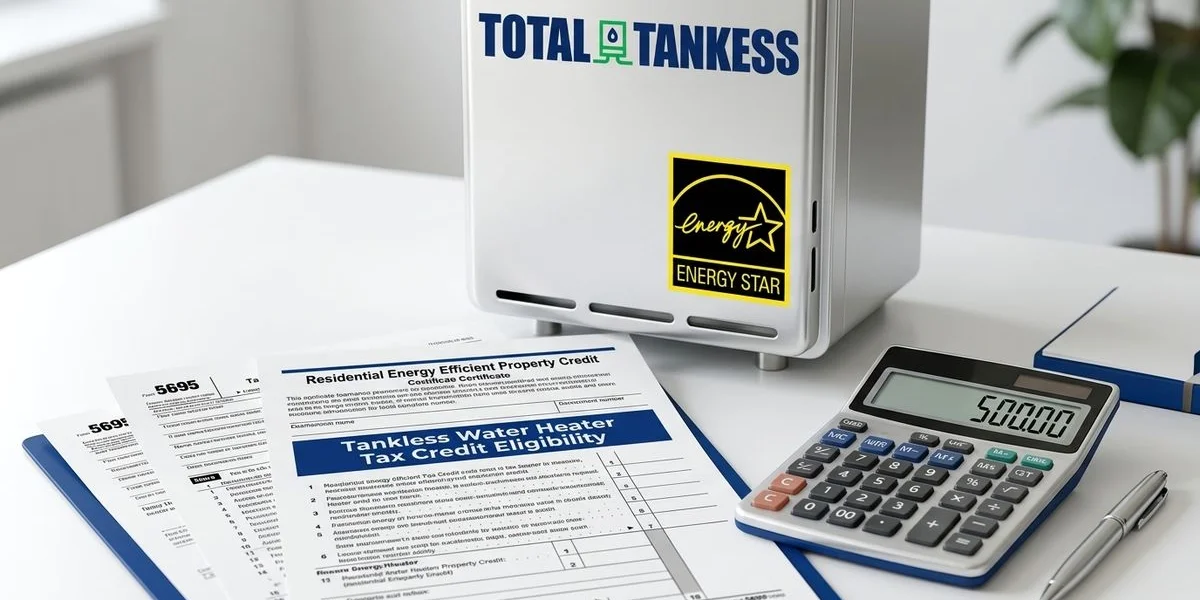
Our clients often appreciate that this is a direct tax credit, rather than a mere deduction. If you owe $4,000 in federal income tax and claim a $600 credit, your final tax bill drops to $3,400.
You must understand the specific caps applied to different water heater technologies. Our experts always clarify that gas-fired tankless models face a strict $600 limit. Hybrid electric heat pump systems can qualify for up to $2,000 under the same law. You can claim these credits in the same year you claim separate incentives for insulation or windows.
Qualifying Requirements
Not every tankless water heater on the market qualifies for federal tax relief. Your chosen unit must hold Energy Star certification and meet strict efficiency standards. We always verify these ratings before quoting a new installation.
- Gas-Fired Models: These units must achieve a Uniform Energy Factor (UEF) of 0.95 or higher. Premium condensing models like the Rinnai RU199iN or the Navien NPE-240A2 easily clear this hurdle with UEF ratings up to 0.96.
- Non-Condensing Gas Models: These typically carry UEF ratings between 0.81 and 0.90. Purchasing a cheaper non-condensing unit means you forfeit the $600 tax credit.
- Electric Tankless Models: These must have a UEF of 2.20 or higher. Standard whole-house electric tankless systems rarely meet this mark, while advanced heat pump units do.
The equipment must be installed in your primary residence. Rental properties, second homes, and new construction projects do not qualify for the 25C credit.
Required Documentation
The IRS introduced stricter reporting requirements starting in 2025 and continuing into 2026. You must now include a four-digit Qualified Manufacturer (QM) code on your tax documents. We ensure every invoice clearly lists this specific pin code for our customers. For instance, Navien uses the code M6G5, while A.O. Smith requires A5X5.
To claim the credit, you need the manufacturer certification statement and an itemized purchase receipt. You then file IRS Form 5695 alongside your annual tax return. Most manufacturers provide the certification statement directly on their websites.
State and Utility Rebates
Local utility incentives often provide even more immediate cash back than federal programs. These regional rebates stack perfectly on top of your federal credit. Our installation teams frequently help customers combine both types of funding. You can claim state money without reducing your federal tax savings.
How to Find Your Local Rebates
The Database of State Incentives for Renewables and Efficiency at dsireusa.org remains the top resource for finding active programs. You simply enter your zip code and filter the results to find these key details:
- Available utility providers
- Specific rebate dollar amounts
- Efficiency requirements for qualification
Our office staff also recommends checking directly with your local gas provider. Common state and utility rebates range from $100 to over $1,000. For example, the Southern California Gas Company (SoCalGas) offers specific tankless replacement rebates in areas like the Inland Empire that often reach up to $1,000 for qualifying natural gas models. Some regional programs base the payout amount on the specific UEF rating of your chosen unit. Certain utility programs also grant discounted installation rates through preferred contractor networks.
Rebate Application Tips
Rebate program funding pools operate on a first-come, first-served basis. You should submit your utility applications within 30 days of completing the installation. We have seen many homeowners lose their rebate because they waited too long.
Always retain copies of your itemized receipts, the manufacturer specification sheet, and the contractor invoice. Several utility providers require a formal pre-approval step before any physical work begins. Submitting incomplete paperwork is the fastest way to get your rebate application denied.
Securing Tankless Water Heater Rebates and Tax Credits: How to Save in 2026
A clear plan ensures you capture every dollar available. We developed this simple checklist to keep our own clients on track. Following these exact steps prevents costly administrative errors.
Here is the precise timeline for locking in your incentives.
- Before installation: Confirm all pre-approval requirements with your local utility company. Select a unit meeting the 0.95 UEF threshold for gas or 2.20 UEF for electric.
- During installation: Ask your contractor for an itemized invoice separating parts and labor. Take clear photographs of the installed unit and the attached rating plate.
- Immediately after: File your state and utility rebate applications within the 30-day window. Keep digital backups of all submission confirmations.
- During tax season: Complete IRS Form 5695 using your manufacturer 4-digit QM code. Attach your itemized receipts to your tax filing records.
Common Mistakes That Disqualify Claims
Small oversights easily derail otherwise valid rebate applications. We constantly monitor these programs to identify where applicants go wrong. Avoiding these specific errors will protect your expected savings.
Choosing a Non-Qualifying Model
Installers sometimes recommend a non-condensing unit to save money on PVC venting materials. You must understand that this choice disqualifies you from the $600 federal credit. The upfront savings on venting materials rarely outweigh the lost tax incentives and higher long-term gas bills.
Missing the QM Code and Documentation
Filing Form 5695 without the newly required Qualified Manufacturer code will trigger an IRS rejection. You need to gather specific items before filing your taxes:
- The 4-digit QM code (like A5X5 or M6G5)
- An itemized installation invoice
- The manufacturer certification statement
We advise getting this paperwork on the exact day of installation so you do not have to hunt for it months later.
Installing Outside a Primary Residence
The federal 25C credit strictly applies to your main, primary home. Landlords installing tankless units in rental properties cannot claim this specific federal credit. Some state and utility programs might still offer rebates for rental properties.
Forgetting to Proactively File Form 5695
Tax credits do not magically appear on your return. You have to actively fill out the form and claim the exact amount. Many people simply forget to hand the paperwork to their accountant.
Example Savings Calculation
Seeing the real numbers highlights just how valuable these combined incentives are. We use this exact math to show property owners their true return on investment. Let us look at a typical high-efficiency installation scenario.
Consider a homeowner installing a Navien NPE-210A condensing tankless water heater featuring a 0.96 UEF. The total project cost for the equipment, labor, and new venting lines comes to $4,500.
| Incentive Source | Incentive Type | Amount Saved |
|---|---|---|
| Federal Government | 25C Tax Credit (30% capped) | $600 |
| State Energy Program | High-Efficiency Upgrade Rebate | $300 |
| Local Gas Utility | Replacement Rebate | $200 |
| Total Combined Savings | Direct Cost Reduction | $1,100 |
This combination reduces the effective out-of-pocket cost from $4,500 down to $3,400. You also secure annual energy savings of $100 to $200 compared to operating an outdated tank model, especially with regular maintenance. The payback period drops to just five to eight years, while the unit will likely last another 12 to 17 years beyond that. Upgrading to a premium tankless system makes incredible financial sense right now.
The Bottom Line
The current landscape of federal, state, and utility incentives presents a massive financial opportunity. We highly encourage property owners to act while these specific funding pools remain active.
A carefully planned upgrade strategy easily offsets a large portion of your initial equipment costs.
Securing your Tankless Water Heater Rebates and Tax Credits: How to Save in 2026 comes down to choosing the right Energy Star model and keeping precise records. Our experience shows that dedicating a little time to the paperwork yields thousands of dollars in real savings.
Contact your tax professional and local plumber today to start planning your high-efficiency upgrade.
Calculate your potential savings with our free tankless cost estimator to see how incentives can reduce your total installation cost.
For a comprehensive overview of all available rebates in your area, visit our rebates page.

Customer experience manager at Total Tankless with a decade of home services expertise.
Need professional help with your tankless water heater?
Learn About Our Tankless Installation Service