
Tankless Water Heater Not Producing Hot Water? Here's What to Check
No hot water from your tankless unit? Walk through the most likely causes — from minimum flow rate issues to gas supply problems — and when to call a pro.
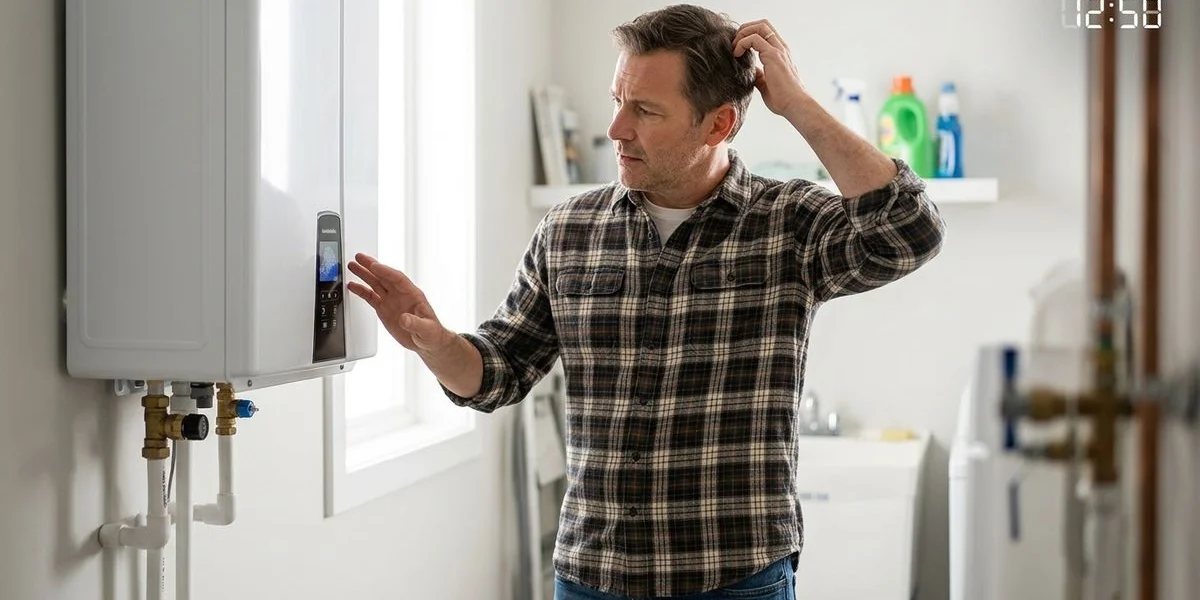
Tankless Water Heater Not Producing Hot Water? Here is a scenario our professional service team encounters constantly. You turn on the faucet expecting instant heat, but the water runs ice cold or quickly drops in temperature.
That sudden blast of cold water is incredibly frustrating. We know how quickly a simple morning routine can turn into a severe repair headache. The good news is that a total system failure is rarely the actual cause.
Let’s look at the specific mechanical data behind these common malfunctions. We will walk through the exact troubleshooting steps you should take to restore your hot water safely.
Check 1: Is the Unit Powered On?
It sounds painfully obvious, but a lack of electrical power is the most commonly overlooked cause. Tankless water heaters require electricity to run the control board, the ignition system, and the internal exhaust fan. Check that the unit’s power cord is securely plugged in and that the electrical outlet has power.
Our technicians frequently discover that a tripped GFCI outlet is the only thing preventing the unit from firing. National Electrical Code (NEC) standards require GFCI outlets in garages and exterior locations across the US. These sensitive outlets can trip easily during minor power fluctuations or storms.
Pro-Tip: The average plumber dispatch fee in the US currently ranges from $150 to $300 just to diagnose a problem. Resetting a tripped breaker or GFCI outlet takes five seconds and saves you that entire diagnostic cost.
If your unit is hardwired, you need to check the dedicated breaker inside your main electrical panel. Power outages, tripped breakers, and tripped GFCI outlets are among the most frequent culprits behind a sudden loss of hot water. We always advise homeowners to check the display screen first. A completely blank display usually confirms an electrical issue.
If the display is dark, reset the breaker or GFCI outlet to see if the unit reboots.
Check 2: Is the Gas Valve Open?
For gas models, you must verify that the gas supply valve on the feed line is fully open. The valve handle should sit perfectly parallel to the gas pipe, rather than perpendicular to it. Our team always checks the broader gas supply before taking apart the water heater. You can test this by checking whether other gas appliances in your home are functioning normally. If your gas stove or furnace also refuses to light, the problem originates with your utility provider.
Gas pressure is another critical factor that homeowners often miss. Proper combustion requires precise pressure from the utility line.
- Natural Gas: Requires 5.0 to 10.5 inches of water column to operate smoothly.
- Propane (LP): Requires 8.0 to 13.0 inches of water column for proper ignition.
If your home runs on propane, checking the main tank level is an absolute necessity. Running low on propane is a surprisingly common reason for ignition failure. We recommend keeping the propane tank above 20% capacity to maintain adequate pressure. A nearly empty tank cannot push enough gas through the regulator.
Check 3: Inspect the Inlet Filter
Every tankless water heater utilizes an inlet water filter screen to catch sediment and debris. This tiny stainless steel mesh protects the internal heat exchanger from serious damage. Over time, this filter can become severely clogged with mineral deposits. A clogged inlet filter restricts water flow so much that the internal sensor fails to activate the burner.
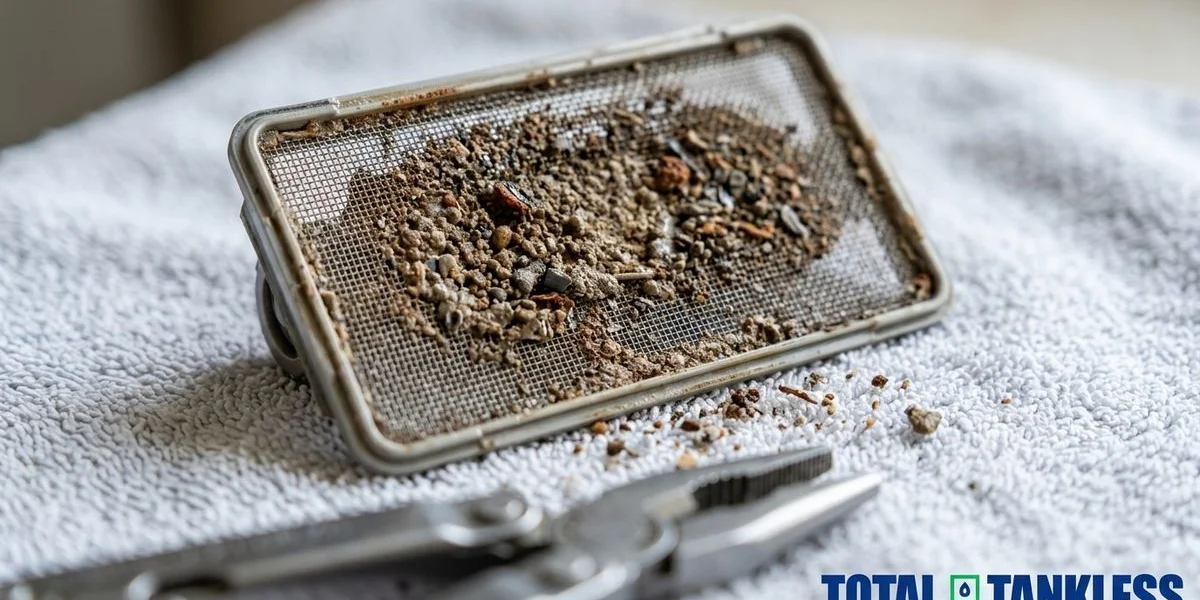
Our service records show that mineral buildup is the leading cause of flow issues. A recent 2026 analysis of US Geological Survey (USGS) data confirms that nearly 85% of American homes deal with hard water. Cities in Texas, Florida, and the Midwest have heavily mineralized groundwater that clogs filters incredibly fast.
To resolve this, you need to check and clean the inlet filter manually.
- Close the isolation valves on both the cold and hot water lines.
- Place a small bucket under the unit to catch residual water.
- Remove the filter screen according to your specific owner’s manual.
- Rinse the stainless steel mesh under running water and reinstall it.
We suggest performing this simple maintenance task at least once a year. If you live in a hard water zone without a dedicated water softener, you should clean this filter every six months. Keeping this screen clear through regular filter replacement guarantees maximum water pressure through the heat exchanger.
Check 4: Minimum Flow Rate Issue
This is arguably the most misunderstood mechanical aspect of tankless technology. Every single unit carries a strict minimum flow rate requirement before it will ignite.
System Fact: Major US brands like Navien design their modern NPE-A2 units to activate at exactly 0.5 gallons per minute (GPM). If the flow rate drops below that threshold, the burner simply will not fire.
Our customers often complain about cold water when washing their hands or shaving at a bathroom sink. If you barely open the faucet, you are likely failing to meet that minimum requirement. The US EPA WaterSense standard restricts modern bathroom faucets to 1.5 GPM at full volume. A partially opened low-flow fixture can easily restrict the flow enough to keep the tankless unit dormant.
You can test this by fully opening a hot water faucet and letting it run for thirty seconds. If the unit fires perfectly at full capacity but fails at partial flow, the machine is working exactly as designed.
You may need to swap out highly restrictive aerators to fix the issue permanently. We occasionally recalibrate internal flow sensors for clients facing persistent issues. A qualified technician can adjust this sensitivity safely.
Check 5: Cross-Flow or Mixing Valve Problems
Modern plumbing systems often utilize recirculation lines, under-sink mixing valves, or single-handle shower controls. These devices can create a frustrating situation known as cross-flow. Cross-flow happens when cold water physically pushes backward into the hot water line. This unwanted mixing dilutes the hot water temperature and tricks the tankless unit’s internal flow sensors.
Our technicians frequently trace this problem back to a single faulty fixture. A failing shower cartridge, like an aging Moen Posi-Temp, or a broken under-sink crossover valve can compromise the entire home’s hot water supply. Quality mixing valves from brands like Watts utilize dual check valves to prevent this exact issue, but those internal seals degrade over time.
You must isolate the problem by checking multiple fixtures throughout the house.
- Test the hot water at the kitchen sink.
- Test the hot water at the guest bathroom shower.
- Test the hot water at the master bathroom sink.
We recommend replacing old shower cartridges if only one bathroom experiences the temperature drop. If the temperature issue is universal across the entire house, the cross-flow is happening near the water heater and requires professional diagnosis.
Check 6: Frozen Pipes in Cold Weather
Plumbing lines can easily freeze during severe winter weather, completely blocking water flow. Ice usually forms in the external water lines leading to the unit or inside the delicate condensate drain line. Many premium tankless units feature built-in ceramic heaters for internal freeze protection. Manufacturers like Rinnai design their internal systems to withstand temperatures dropping to negative 22 degrees Fahrenheit.
That internal protection does absolutely nothing for your external plumbing pipes. Our emergency service calls skyrocket during winter because exposed inlet pipes freeze solid. You must visually inspect any exposed water lines near the exterior of the unit.
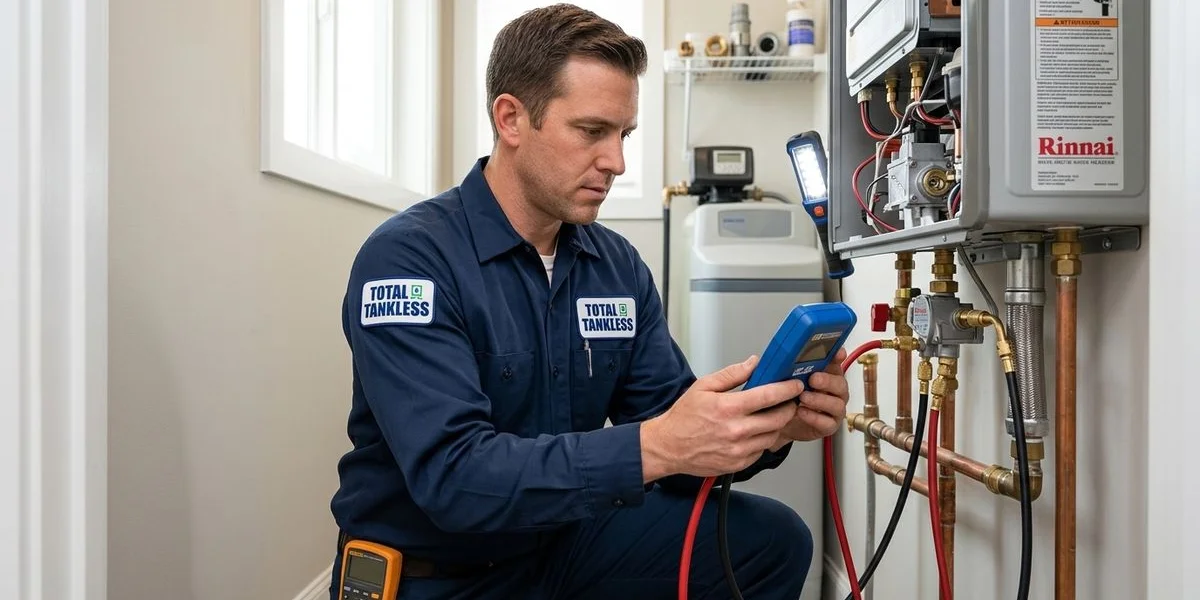
Safety Warning: Never use an open flame or a blowtorch to thaw a frozen water line. A standard hair dryer or a portable space heater aimed at the frozen section is the only safe approach.
We highly recommend wrapping all exposed exterior lines with heavy-duty R-3 or R-4 pipe insulation. Installing thermostatic heat tape is another essential preventive measure for homes located in harsh winter climates.
Check 7: Error Code on the Display
Modern tankless water heaters utilize digital displays to communicate exactly what is going wrong inside the cabinet. If your screen is flashing a number, that specific error code is your best diagnostic tool. You should immediately refer to your owner’s manual to translate the code.
Our diagnostic process always begins by reading these specific manufacturer codes. While every brand uses a different numbering system, the actual failures fall into a few predictable categories.
| Common Error Code Types | Typical Cause | Required Action |
|---|---|---|
| Ignition Failure (e.g., Rinnai Code 11 or Navien E003) | Closed gas valve, low gas pressure, or blocked venting. | Check gas supply and clear external vents. |
| Flame Loss (e.g., Rinnai Code 12) | Dirty flame rod or severe gas pressure drop. | Requires internal cleaning by a professional. |
| Water Flow Control (e.g., Rinnai Code 65) | Failed water flow control valve. | Turn off water immediately and call a plumber. |
Each error code points directly to a compromised system component. Resetting the unit will clear the code temporarily, but a persistent mechanical failure will trigger the code again immediately.
We strongly suggest taking a photo of the code before you reset the breaker. This gives your plumber a massive head start on the repair.
Tankless Water Heater Not Producing Hot Water? Here Is When DIY Troubleshooting Is Enough
Basic troubleshooting can save you significant time and money. If you discovered a tripped electrical breaker, a closed gas valve, or a clogged inlet filter, your DIY efforts have likely solved the problem entirely. Resolving a minimum flow rate issue by simply opening the faucet further is another instant fix.
Our goal is to help you avoid paying a standard dispatch fee for a simple adjustment. These basic electrical, gas, and flow restrictions are the most common culprits behind cold water. They do not indicate a catastrophic system failure or require expensive replacement parts.
Tankless Water Heater Not Producing Hot Water? Here Is When to Call a Professional
Certain mechanical failures require the tools and training of a licensed plumbing technician. You should schedule a service appointment immediately if you encounter severe warning signs.
- Persistent error codes that return after a reset.
- Rapid clicking sounds without actual ignition.
- Loud pops or bangs during operation.
- Visible signs of water leaking from the internal cabinet.
Our company strictly advises against disassembling any gas-fired appliance without proper certification. Attempting to repair internal gas valves or sealed combustion chambers is incredibly dangerous. Tinkering with these highly sensitive components will almost certainly void your manufacturer’s warranty.
Is your Tankless Water Heater Not Producing Hot Water? Here is our final piece of advice for property owners. We always prioritize safety over saving a few dollars on a service call.
If you have worked through every item on this diagnostic checklist and the water remains cold, it is time to call an expert. A qualified technician possesses the diagnostic software and the US-certified gas training required to repair your system safely. Contact a licensed local plumber today to restore your hot water system.
Licensed master plumber and lead technical advisor at Total Tankless with 25+ years of tankless water heater expertise.
Need professional help with your tankless water heater?
Learn About Our Tankless Repairs Service