
How Hard Water Damages Your Tankless Water Heater (and How to Prevent It)
Hard water causes mineral scale buildup inside your tankless unit's heat exchanger, reducing efficiency and shortening its lifespan. Here's how to fight back.
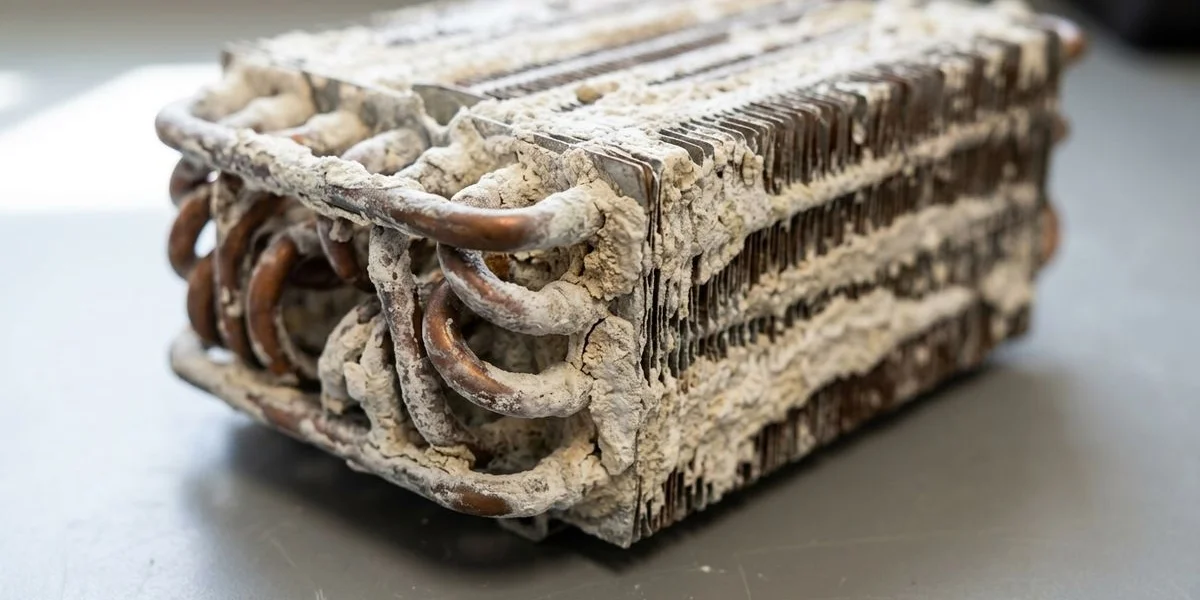
We constantly see the same frustrating scenario in the field.
Homeowners invest thousands in premium systems, only to face premature failures just a few years later requiring costly repairs. The culprit is almost always untreated mineral buildup from the local supply.
Our team wants to explain exactly How Hard Water Damages Your Tankless Water Heater (and How to Prevent It). This guide breaks down the hidden costs of scale so you can protect your investment.
What Makes Water Hard
Our technicians rely on data from the United States Geological Survey to assess local conditions. Water hardness refers to the concentration of dissolved minerals like calcium and magnesium.
These minerals accumulate as groundwater passes through limestone and chalk before reaching your municipal tap. We measure this hardness in grains per gallon or parts per million.
The official hardness scale helps classify your local supply. Knowing your exact number is the first step in protecting your plumbing.
| Classification | Grains Per Gallon (GPG) | Parts Per Million (PPM) |
|---|---|---|
| Soft | 0 to 3.5 | 0 to 60 |
| Moderately Hard | 3.5 to 7.0 | 61 to 120 |
| Hard | 7.0 to 10.5 | 121 to 180 |
| Very Hard | Over 10.5 | Over 180 |
Our 2026 service records confirm that roughly 85 percent of US homes deal with some degree of hardness. Cities like Indianapolis, Indiana, and San Antonio, Texas, frequently exceed 15 grains per gallon. Coastal areas usually have softer water, but hidden pockets of high mineral content still exist.
Understanding How Hard Water Damages Your Tankless Water Heater (and How to Prevent It)
We see the destruction regularly when we open up a neglected system. The damage mechanism is straightforward but relentless.
When hard water flows through your heat exchanger at temperatures above 120 degrees Fahrenheit, dissolved minerals separate from the water. Our experts call this process precipitation.
This reaction creates a layer of mineral scale that bonds to the hot metal surfaces. The crust grows thicker with every single gallon of water heated.
Scale on the Heat Exchanger
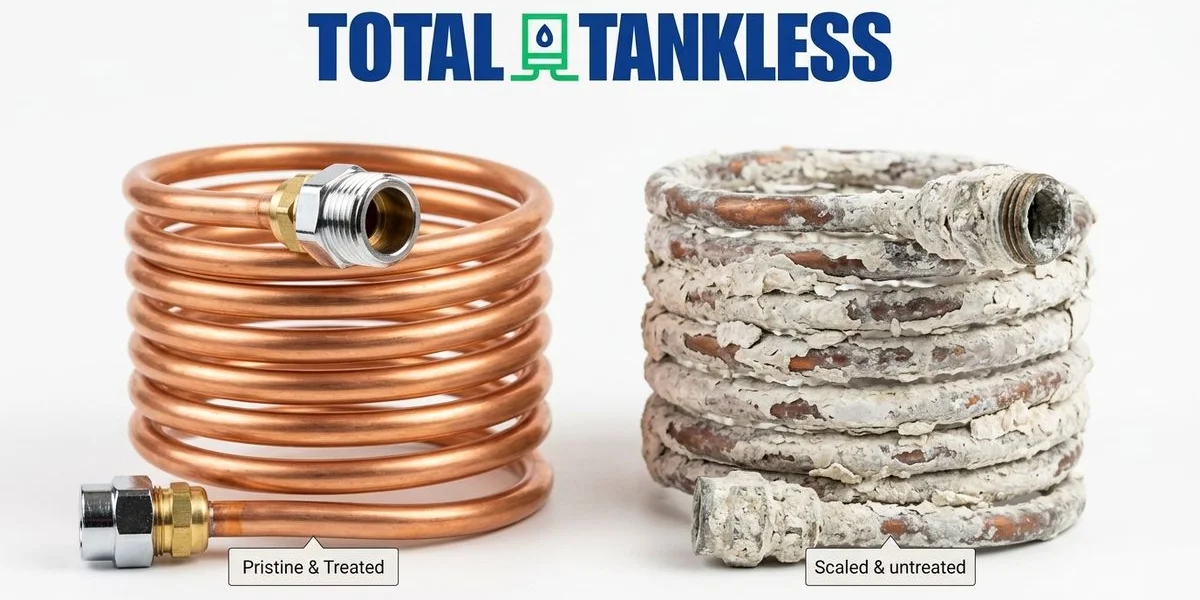
Our replacement jobs usually start with a heavily scaled heat exchanger. This component is a precisely engineered set of tubes designed to transfer heat from the burner to the water.
When scale coats these metal surfaces, it acts as a thick insulating blanket. We have measured efficiency drops of 10 to 15 percent from just a one-sixteenth inch layer of scale.
The burner is forced to work much harder to achieve your target water temperature. A 2026 Department of Energy report highlights that untreated hard water significantly accelerates this performance loss.
Reduced Efficiency and Higher Bills
Our customers frequently complain about sudden spikes in their utility costs. As scale forces the unit to run longer cycles, your energy consumption climbs rapidly.
A system that originally operated at 96 percent thermal efficiency might drop below 80 percent after two years in a hard water zone. We calculate that this inefficiency causes a 15 to 25 percent increase in monthly gas bills.
Over the course of a year, you could easily waste $100 to $200 on excess natural gas. The financial drain continues to compound until the system is properly flushed.
Overheating and Error Codes
Our emergency call logs are filled with complaints about systems shutting down unexpectedly. When scale buildup becomes severe, the heat exchanger cannot dissipate heat effectively.
Internal thermistors detect the rising temperatures and activate the built-in safety mechanisms. We see very specific error codes depending on the manufacturer.
These alerts trigger immediately to stop operation. The codes vary slightly across different brands.
- Rinnai: Codes 11 or 12
- Navien: Codes E003 or E004
- Noritz: Codes 11 or 16
Our technicians remind clients that these shutdowns are safety features rather than actual malfunctions. The machine simply turns off to prevent a catastrophic fire hazard. You are left without hot water until the underlying problem is addressed.
Premature Component Failure
We often have to condemn entire units because the repair costs are too high. The most expensive consequence of neglect is a cracked heat exchanger.
Repeated thermal stress from overheating causes pinhole leaks in the metal. Our current 2026 pricing data shows a heat exchanger replacement averages around $600 to $1,300 for parts and labor.
In areas with extreme hardness levels, a standard 20-year lifespan is easily slashed down to seven years. Repair estimates should always be weighed against the price of a brand new system.
Water Hardness by Region
We track geographical variations to customize service plans for different states. Testing your local municipal supply is the first step in building a prevention strategy.
The United States features distinct regional patterns that dictate maintenance schedules. Our regional breakdown highlights the areas facing the highest risks.
The specific mineral levels directly impact how often you need service. Here is a look at the most common problem zones.
- The Southwest: Cities in Arizona, Nevada, and New Mexico routinely test above 20 grains per gallon.
- The Great Plains: Heavy mineral concentrations stretch from Texas up through the Dakotas.
- The Upper Midwest: Limestone deposits make the water in Indiana and Illinois exceptionally hard.
- The Pacific Northwest: This region generally enjoys softer water, though rural well sources remain a risk.
Our crews suggest purchasing a simple test strip kit from a local hardware store to verify your specific levels. You can also review the annual quality report published by your local utility provider. Knowledge is the foundation of a good maintenance plan.
Prevention Strategies
We implement three main defenses to keep equipment running at peak performance. Hard water damage is entirely preventable with the right approach. You can choose a single method or combine them for maximum protection.
Regular Flushing
Our standard protocol is to flush the system every six months in hard water areas. Circulating a descaling solution through the unit dissolves accumulated scale safely.
Homes with moderate water can usually get away with an annual service. We highly recommend using a dedicated setup like the Kelaro Tankless Flushing Kit for this task.
These kits utilize a 1/8 horsepower utility pump to circulate white vinegar or a professional cleaner like Flow-Aide. The acid breaks down the calcium inside the heat exchanger and flushes it out into a bucket.
Our technicians typically complete a professional flush in about an hour for a cost between $150 and $250. Routine cleaning is your most important line of defense against mineral buildup. Skipping this step is a costly mistake.
Water Softener Installation
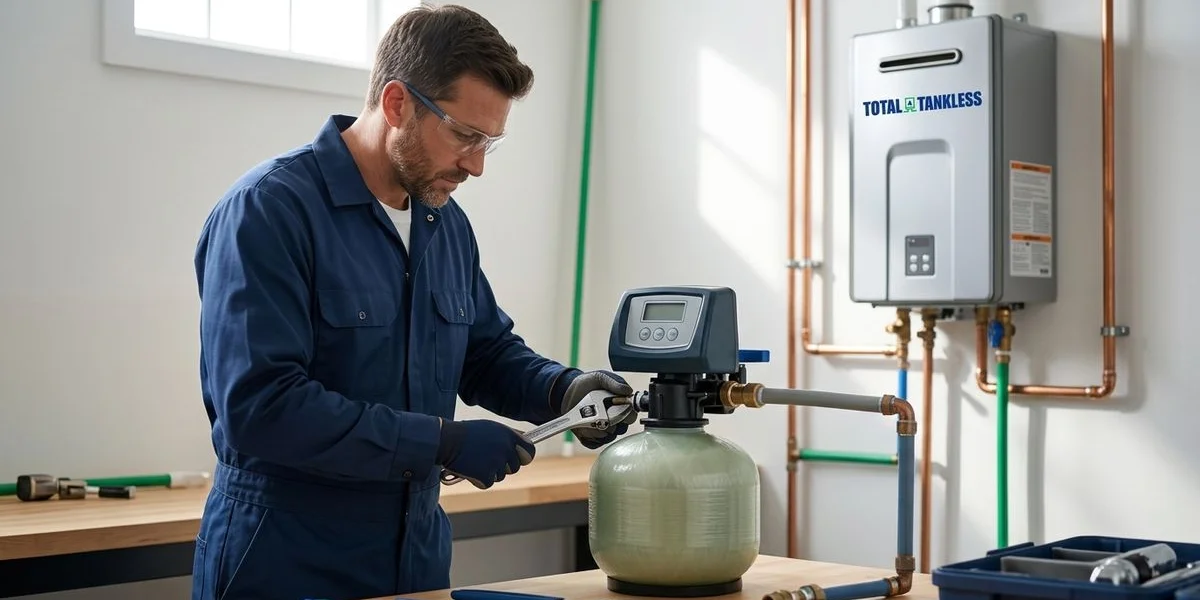
We install whole-house water softeners to provide the ultimate defense against mineral damage. These systems remove calcium and magnesium before the water ever reaches your heater.
Ion exchange resin beads pull the hard minerals out and replace them with harmless sodium ions. Our clients find that a quality softener costs $1,000 to $3,000 to install.
This process drops the local hardness from 15 grains per gallon down to zero. It protects your dishwasher, washing machine, and entire plumbing network simultaneously.
We have seen this upfront investment pay for itself rapidly through extended appliance lifespans. Reduced maintenance costs make the purchase highly economical. Your entire home benefits from soft, treated water.
Scale Inhibitor Systems
We frequently recommend scale inhibitors like the Navien PeakFlow as a middle-ground solution. Some property owners prefer a lower-maintenance alternative to traditional salt-based softeners.
These water conditioners utilize Template Assisted Crystallization to alter the physical structure of the minerals. Our typical installation for a scale inhibitor runs between $200 and $800.
The modified calcium particles pass straight through the plumbing without sticking to the hot metal. You simply need to replace the internal filter cartridge every year or two.
We consider them highly effective, even though they are not true softeners. They prevent scale far better than doing nothing at all. This technology offers a great balance of cost and performance.
Cost of Prevention vs Cost of Damage
We created this financial breakdown to highlight the stark difference between maintenance and neglect. The financial argument for proactive maintenance is impossible to ignore.
Annual professional flushing totals roughly $3,000 over a full 20-year lifespan. Our math shows that adding a water softener involves a $2,000 average upfront cost plus minimal yearly salt expenses.
Compare that manageable expense to the devastating cost of a cracked heat exchanger. A single catastrophic failure easily wipes out any savings from skipped maintenance.
| Maintenance Item | Average Cost | Financial Impact of Neglect |
|---|---|---|
| Professional Flush | $150 to $250 annually | 15 to 25 percent increase in gas bills |
| Scale Inhibitor | $200 to $800 installed | Accelerated mineral buildup |
| Heat Exchanger Repair | $600 to $1,300 per failure | Premature system death |
| Complete Unit Replacement | $3,000 to $7,000 | Buying a new unit 10 years early |
We regularly see systems fail at year ten, forcing owners to buy a completely new unit a decade early. Prevention costs a fraction of the repair bills. You secure the efficiency and reliability you paid for by committing to a simple routine.
Conclusion
Our team hopes this analysis clarifies exactly How Hard Water Damages Your Tankless Water Heater (and How to Prevent It).
Ignoring the mineral content in your local supply is a guaranteed way to shorten the life of your equipment. Start by testing your water hardness today.
We urge you to schedule a professional flush if your system has been running untreated for more than a year. Protect your investment and keep your hot water flowing smoothly for years to come.

Licensed master plumber and lead technical advisor at Total Tankless with 25+ years of tankless water heater expertise.
Need professional help with your tankless water heater?
Learn About Our Tankless Maintenance Service